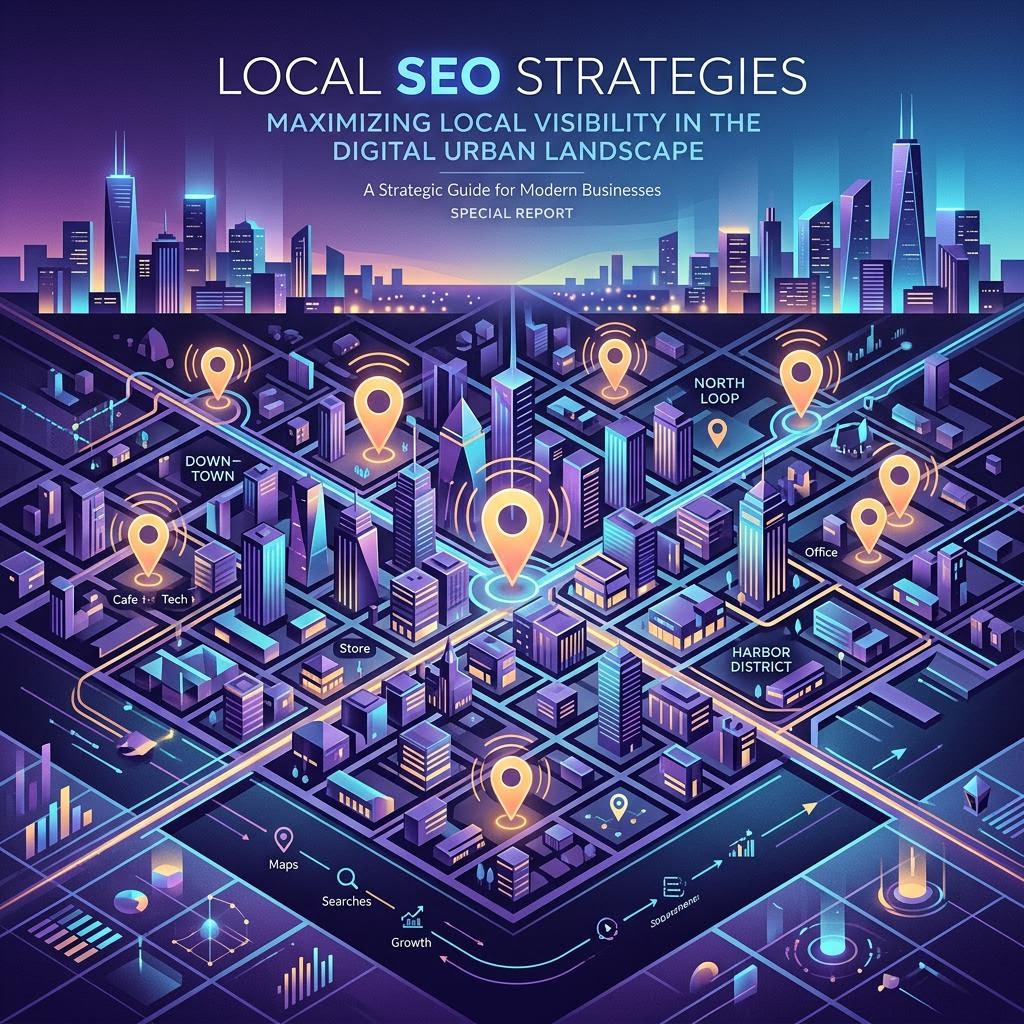
Why Houston Local SEO Is Different
Houston is the fourth-largest city in the United States by population and — by land area — one of the largest in the world. Greater Houston spans over 10,000 square miles of metropolitan area, encompasses 9 counties, contains more than 80 incorporated municipalities, and is home to over 7 million people speaking more than 145 languages.
That scale creates a local SEO environment unlike almost any other U.S. market. A roofing contractor in The Woodlands is not competing in the same local pack as a roofing contractor in Pearland — those are 60 miles apart. A restaurant in Montrose serves an entirely different neighborhood ecosystem than a restaurant in Sugar Land. Local SEO in Houston is not "one city" optimization; it is a strategic decision about which geographic markets to prioritize, which suburbs to target, and how to build authority that extends across a sprawling, decentralized metro.
Houston's competitive dynamics also differ from many markets. The city has high business density in service sectors such as HVAC, plumbing, roofing, concrete, and landscaping. This density makes local pack competition intense, so improvements in map visibility can materially affect how often nearby customers discover and contact a business.
Finally, Houston's diversity creates a multilingual local search dimension that few businesses exploit. A significant portion of Houston searches — particularly in Southwest Houston, Spring Branch, and parts of Harris County — occur in Spanish. Businesses with Spanish-language GBP profiles, Spanish content, and Spanish citation presence capture a market segment their English-only competitors ignore entirely.
How the Local Pack Works
The Google local pack — the 3-business listing with map that appears at the top of local search results — is determined by a three-factor algorithm: proximity, relevance, and prominence.
Proximity is the distance between the searcher's location and your business address. Google weighs proximity heavily for most local queries. For Houston's sprawling market, this means a single location cannot realistically rank in the local pack for users searching from across the metro — which is why service-area businesses and multi-location strategies matter.
Relevance is how closely your Google Business Profile and website content match what the searcher is looking for. Relevance is shaped by your primary category, secondary categories, business description, services listed in your GBP, and the content of your website's pages that Google associates with your local entity.
Prominence is your overall authority in Google's local index — shaped by the quantity and quality of reviews, the volume and consistency of citations across the web, the number and quality of links to your website, and your overall organic search authority. Prominence is the factor most directly influenced by active local SEO work.
Understanding these three factors clarifies why local SEO is not a simple checklist. Proximity is largely fixed by your location. Relevance is established by configuration. Prominence is built over time through consistent, compounding effort — reviews, citations, content, and links.
Local SEO operating scorecard
Track coverage by neighborhood or grid point; location is a constraint, not a copywriting task.
Audit categories, services, landing pages, and language against real customer queries.
Monitor review recency, citations, local links, and useful mentions over time.
Connect GBP actions and organic leads to qualified calls, estimates, and booked work.
Google Business Profile: The Non-Negotiable Foundation
Every local SEO initiative begins with the Google Business Profile. For most local searches, your GBP is the first impression, the primary source of contact information, and the primary conversion touchpoint — even before a user visits your website.
Category selection is the highest-leverage GBP element. Your primary category signals to Google exactly what type of business you are. Selecting a broad category ("Contractor") when a specific one exists ("Roofing Contractor") wastes the specificity that determines which local pack you appear in. For Houston service businesses, use the most specific category that accurately describes your primary service. Then use secondary categories for each additional real service you provide.
Your business description should be concise and locally grounded. Include your primary service type, the Houston markets you genuinely serve, and useful differentiating facts. Follow Google's current field limits and avoid keyword stuffing. Write for customers first; do not assume the description alone determines ranking.
The services section is underused by most Houston businesses. GBP allows you to list individual services with descriptions under each category. A plumbing business can list "Water Heater Replacement," "Slab Leak Detection," "Drain Cleaning," "Hydrojetting," and "Re-piping" as individual services with keyword-rich descriptions. Each service entry contributes to relevance matching for specific query types.
Photos support user experience and profile completeness. Use accurate interior, exterior, team, and work-in-progress photos, and refresh them when the business or work changes. Google does not publish a minimum photo count or a guarantee that photo quantity improves ranking. Customer photos can add useful third-party context when they are genuine.
NAP Consistency and the Citation Ecosystem
NAP — Name, Address, Phone — is the core entity data that Google uses to verify and understand your business. Every time Google sees your NAP consistently replicated across a credible directory, that consistency adds a micro-signal of confidence to your entity record. Every inconsistency reduces confidence.
The Houston business directory ecosystem is layered. At the foundation are the major data aggregators: Acxiom, Foursquare, Neustar Localeze, and Data Axle (formerly Infogroup). These aggregators feed your business data to hundreds of downstream directories — Yelp, Yellow Pages, MapQuest, Apple Maps, and many others. If your NAP data is wrong at the aggregator level, it propagates incorrectly to dozens of directories. Fix aggregators first.
Beyond the aggregators, Houston-specific citation sources carry local authority weight: the Greater Houston Partnership business directory, the Houston Better Business Bureau, the Houston Chronicle's business section, local neighborhood association directories (particularly in Meyerland, Bellaire, and Heights), and industry-specific associations like the Air Conditioning Contractors of America Houston chapter.
The most common Houston NAP inconsistencies to audit for: business name formatted with "LLC" in some listings and without in others; suite numbers included in some addresses and omitted in others; tracking phone numbers from old Google Ads campaigns left as primary numbers in directories; and pre-rebranding business names in directories that were never updated after a name change.
Local Content Strategy for Houston
Local content — web pages and articles specifically written to address local search intent — is the organic counterpart to your GBP work. Where GBP earns local pack rankings, local content earns traditional organic rankings on queries that don't trigger a local pack. Together they cover the full spectrum of local search.
Effective local content for Houston service businesses falls into three categories. Service + location pages target queries like "roof replacement Houston" and "HVAC repair Spring TX" — specific service paired with a specific market. Educational local content targets questions Houston residents ask while researching: "what causes slab leaks in Houston clay soil," "best grass types for Houston humidity," "hurricane season roof inspection checklist Houston." Community content establishes local entity signals: project spotlights in specific Houston neighborhoods, local customer success stories with city-specific details, and coverage of local events or weather-driven service needs.
Houston has specific environmental and infrastructure conditions that create legitimate, valuable local content opportunities. The city's expansive clay soil causes foundation movement and plumbing problems distinct from most U.S. markets. The humid subtropical climate drives specific HVAC and roofing considerations. Houston's bayou system and flood history create legitimate drainage, foundation, and waterproofing content that national content does not address. These local content angles create genuine informational value and are essentially uncontested by national competitors.
Neighborhood and Suburb Targeting
Houston's geographic sprawl creates a neighborhood and suburb targeting opportunity that most local businesses underexploit. Searches with neighborhood-level specificity — "plumber Katy TX," "roofing contractor The Woodlands," "electrician Sugar Land" — are high-intent, lower-competition, and extremely relevant to how Houston residents actually search.
The key markets for suburb-level targeting in Houston's metro: The Woodlands (wealthy, family-oriented, high home values, strong service market), Katy (fastest-growing suburb, enormous new construction volume), Sugar Land (affluent, high home value, strong improvement market), Pearland (rapidly growing, younger demographics), League City / Clear Lake (Space Center corridor, steady growth), Cypress (large suburban sprawl with strong home services demand), and Spring / Tomball (north Houston growth corridor).
City-level pages should be built for each priority market, but only with genuine local content — not thin templates with the city name swapped in. At minimum, a Katy landing page should include: specific Katy subdivisions served, Katy-specific environmental or home considerations, any notable Katy projects, and local community references that signal genuine familiarity with the area. Google's Helpful Content system is specifically designed to detect and suppress location pages that lack genuine local value.
Local Link Building in Houston
Local links — links from Houston-based websites to your website — are among the strongest prominence signals in the local algorithm. Unlike national link building, local link building is less competitive and often more relationship-driven.
The most effective Houston local link sources: Houston Chamber of Commerce membership (multiple chambers: Greater Houston Partnership, various suburb chambers in Katy, Sugar Land, The Woodlands), Houston Better Business Bureau accreditation (a link from bbb.org carries real authority), Houston Press and CultureMap Houston (local news and culture publications that cover local business stories), local neighborhood associations (Heights Association, Montrose Management District, etc.), Houston-area supplier or vendor directories (your material suppliers often have contractor directories), and local charity or community sponsorship pages (Houston Food Bank, local little leagues, community events).
The most sustainable local link building strategy is to be genuinely embedded in the Houston business community — join associations, sponsor local events, participate in local business groups — and ensure every real-world involvement has a corresponding link. The organic link earning from real community participation outperforms manufactured link building and carries no algorithm risk.
The Review Strategy That Actually Moves Rankings
Reviews are one part of local prominence and are also a major trust signal for customers. The relationship between reviews and rankings is not a public formula; do not treat velocity, recency, platform diversity, keywords, or response rate as guaranteed ranking levers.
Consistency matters operationally. Build a policy-compliant system for requesting honest reviews from customers rather than relying on a one-time spike. Review recency and volume may affect how customers perceive a profile, but Google does not publish a rule that a particular monthly number will outperform an older review base.
Response rate matters. Google's own documentation states that responding to reviews shows that your business values customer feedback. Businesses with high response rates — responding to both positive and negative reviews within 24 to 48 hours — demonstrate an engagement signal that contributes to prominence scores.
Platform diversification matters. Google reviews are primary, but Yelp, Facebook, and industry-specific review platforms (Houzz for home improvement, Avvo for legal, Healthgrades for medical) provide secondary authority signals. A business with 50 Google reviews and 20 Yelp reviews has a stronger overall review authority than a business with 70 Google reviews and none elsewhere.
A post-job message with a direct review link can make feedback convenient; choose timing and wording that fit your customer relationship and comply with Google's policies. Do not promise a response rate, gate requests, or incentivize reviews.
Tracking Your Local Rankings
Standard keyword rank trackers report rankings from a fixed point — which does not reflect how local search actually works. Local pack rankings vary dramatically based on the searcher's physical location. A plumber who ranks #1 in the local pack for a user one mile away might rank #5 for a user five miles away.
The right tool for Houston local rank tracking is a grid-based rank tracker — tools like BrightLocal's Local Rank Tracker, Local Falcon, or STAT Search Analytics — that simulates searches from dozens of geographic points across your service area and shows how your local pack position varies across the Houston metro. This grid view reveals where you are dominant, where you are weak, and which areas represent the highest-priority improvement targets.
In addition to grid-based local tracking, monitor: Google Business Profile Insights (search queries, discovery vs. direct searches, photo views, call clicks, direction requests), Google Search Console (organic impressions and clicks with location filter), and call tracking if you have the infrastructure — attributing inbound calls to their organic search source is the most direct measurement of local SEO's revenue contribution.
Choose priority markets
Select the Houston neighborhoods and suburbs that fit capacity, travel time, margins, and existing customer demand.
Baseline the grid
Record local-pack positions, GBP actions, calls, forms, and booked jobs from representative points before changing the profile.
Improve and review
Address the weakest factor—relevance, prominence, or conversion experience—then compare the same locations and time window monthly.
Houston local SEO is a long game. The businesses that build citation consistency, review velocity, local content depth, and community link authority over 12 to 24 months become extremely difficult to displace. The businesses waiting for a one-month fix will find themselves permanently trailing behind those that started building six months ago. The best time to start is now.